
Do's and Don'ts for Lyme Disease
Early action makes all the difference with Lyme disease. This guide covers the essential do's and don'ts — from tick removal and symptom recognition to testing pitfalls and treatment follow-through.
7/6/20263 min read
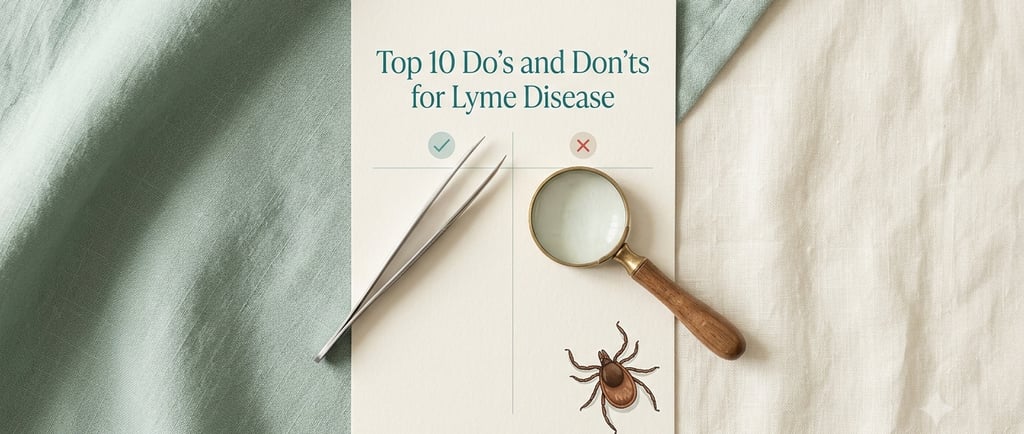
Top 10 Do's and Don'ts for Lyme Disease
Lyme disease is the most common tick-borne illness in the United States, and early, informed action makes a real difference in outcomes. Whether you've just found a tick, received a diagnosis, or are supporting your recovery, here's what matters most.
The Do's
1. Do remove a tick correctly and promptly. Use fine-tipped tweezers, grasp the tick as close to the skin as possible, and pull straight up with steady, even pressure. Clean the bite area with rubbing alcohol or soap and water afterward. The faster a tick is removed, the lower the risk of transmission — most experts agree infection risk rises significantly after 24-36 hours of attachment.
2. Do watch for early symptoms. The classic "bullseye" rash (erythema migrans) appears in a majority of cases, but not all. Also watch for fever, chills, fatigue, headache, and muscle or joint aches in the days to weeks after a bite. Symptoms can be subtle or easily mistaken for a summer flu.
3. Do see a doctor promptly if you suspect exposure. Early treatment, usually with a course of antibiotics, is highly effective and is the single biggest factor in preventing Lyme disease from progressing to more serious, harder-to-treat stages.
4. Do save the tick if possible. Placing it in a sealed bag or container (dead or alive) allows for identification and, in some cases, testing — useful information for your provider.
5. Do take your full course of treatment as prescribed. Stopping antibiotics early, even if you feel better, can allow the infection to persist or resurface.
6. Do support your body through recovery. Adequate sleep, hydration, anti-inflammatory nutrition, and stress management all support immune function during and after treatment. Some patients also benefit from working with a provider experienced in tick-borne illness on a broader recovery plan.
7. Do get tested appropriately. Lyme testing (like the two-tier ELISA/Western blot approach) is most reliable a few weeks after exposure, once antibodies have developed. If you test too early, a false negative is possible — testing may need to be repeated.
8. Do take prevention seriously in tick season. Use EPA-registered repellents, wear long sleeves/pants in wooded or grassy areas, treat clothing and gear with permethrin, and do thorough tick checks after being outdoors — including scalp, behind ears, and skin folds.
9. Do communicate clearly with your care team about lingering symptoms. Some people experience post-treatment symptoms (fatigue, joint pain, brain fog) for weeks or months. This is a recognized phenomenon worth tracking and discussing openly rather than dismissing.
10. Do check your pets too. Dogs and cats can carry ticks into the home and can themselves contract tick-borne illness. Regular tick prevention for pets protects your whole household.
The Don'ts
1. Don't use folklore removal methods. Petroleum jelly, nail polish, a hot match, or twisting the tick can agitate it and increase the risk of it releasing infected fluid into the bite. Tweezers and steady pressure only.
2. Don't wait and see if symptoms are mild. Lyme disease is far easier to treat early. Waiting for symptoms to "prove themselves" can allow the infection to spread to joints, the nervous system, or the heart.
3. Don't assume no rash means no infection. Not everyone develops the classic bullseye rash, and some rashes look different than textbook images. Absence of a rash doesn't rule out Lyme disease.
4. Don't rely on a single negative test to close the door. Early-stage antibody tests can return false negatives. If clinical suspicion remains high, retesting or further evaluation may be warranted.
5. Don't skip or shorten antibiotics without medical guidance. Even if symptoms resolve quickly, cutting treatment short is one of the most common reasons for relapse or incomplete clearance.
6. Don't ignore new or unusual symptoms after treatment. Fatigue, joint pain, or cognitive changes that appear or persist after treatment deserve follow-up rather than being brushed off as "just stress."
7. Don't self-diagnose based on internet symptom lists alone. Lyme disease symptoms overlap with many other conditions. A proper clinical evaluation, ideally with someone experienced in tick-borne illness, is important for an accurate diagnosis.
8. Don't underestimate co-infections. Ticks can transmit more than one pathogen at once (such as Babesia or Anaplasma). If symptoms don't fully resolve as expected, ask your provider about testing for co-infections.
9. Don't assume you're only at risk in "the woods." Ticks live in tall grass, leaf litter, and even well-maintained backyards, especially at the edges of lawns near woods or brush.
10. Don't go it alone if recovery feels complicated. Chronic or lingering symptoms can be frustrating and isolating. Working with a knowledgeable care team — rather than piecing together advice from scattered sources — leads to a clearer, more supported path forward.
This article is intended for general educational purposes and is not a substitute for personalized medical advice. If you suspect you have Lyme disease or are experiencing symptoms, please consult a qualified healthcare provider.
Renew Life Clinic
Applied kinesiology and clinical protocols for chronic Lyme and autoimmune recovery.
Home-Services-About-Contact
The Practice
renewlifeclinicsupport@gmail.com
Appointments by referral & scheduling
© 2025 Renew Life Clinic Natural Medicine. -Clinical natural medicine for complex chronic conditions.
Neurological Biofeedback & Clinical Protocols