
European vs. American Food Systems: What's Actually Different (and What Isn't)
"Autoimmune disease has become dramatically more common over the past few decades. This post breaks down what the data actually shows, the leading theories behind the rise — from gut microbiome disruption to environmental exposures — and which populations face the greatest risk, and why."
7/11/20265 min read
European vs. American Food Systems: What's Actually Different (and What Isn't)
If you've spent time in Germany, Denmark, France, or elsewhere in Europe and come home feeling like the food "just sits differently," you're not imagining the regulatory gap — it's real and well-documented. But the picture is more nuanced than "Europe bans chemicals America allows," and it's worth understanding the actual differences before drawing conclusions about health outcomes.
Different Starting Philosophies
The biggest structural difference isn't any single chemical — it's the regulatory philosophy underneath the whole system.
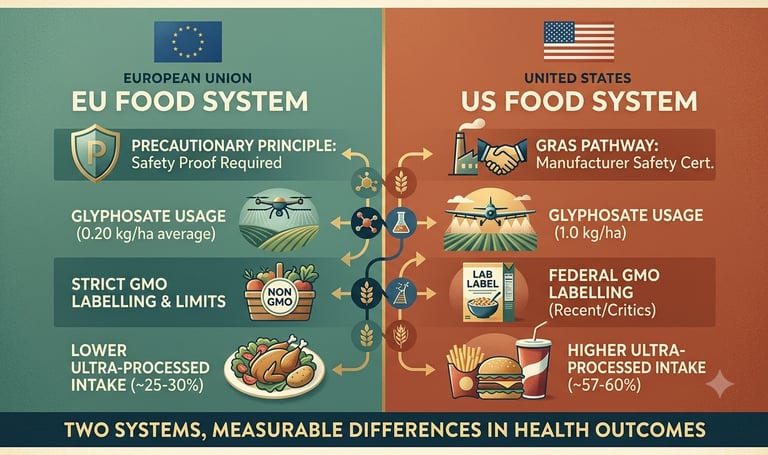
The EU generally operates on the precautionary principle: new substances are restricted or banned until there's sufficient evidence they're safe. The US system, by contrast, generally allows ingredients to be used unless and until they're proven harmful — and a lot of that initial safety determination happens through self-certification by manufacturers under the FDA's "Generally Recognized as Safe" (GRAS) pathway, rather than mandatory pre-market government review.
This single philosophical difference cascades into most of the specific gaps people notice.
Food Additives
This is one of the starkest differences. The United States has roughly 3,000 food additives approved for use, while the EU has restricted or banned hundreds of substances still permitted in the US — including certain artificial dyes, preservatives, and growth hormones used in livestock.
Pesticides, Including Glyphosate — Usage Really Is Lower
Here's a concrete number: in 2014, U.S. farmers applied roughly 1.0 kg of glyphosate per hectare of cultivated cropland. The EU-wide average in 2017 was roughly 0.20 kg per hectare — about a fifth of the US rate. Europe simply doesn't spray at the same volume or frequency, and the EU also sets meaningfully lower maximum residue limits for pesticides in food and stricter limits in drinking water. The US has raised allowable glyphosate residue limits on some crops over time, partly to accommodate practices like pre-harvest desiccation spraying (spraying crops like oats and wheat shortly before harvest to dry them faster) — a practice far more common in the US than in most of Europe.
Why the gap exists: U.S. row-crop agriculture is built around glyphosate-tolerant "Roundup Ready" corn, soy, and cotton, which allows broadcast spraying directly over growing crops — a practice that expanded dramatically after these seed varieties were introduced in 1996 and drove a roughly 15-fold increase in global glyphosate use, with the U.S. absorbing a disproportionate share. That single agricultural design choice — building a food system around a crop-and-chemical combination that permits far heavier, more frequent application — is arguably the clearest, most concrete difference between the two systems.
If you're picking countries to point to as the clearest examples of the gap, Denmark, France, and Germany, or especially lower-intensity countries like Latvia, Lithuania, and Ireland, are your strongest, best-supported examples (Belgium and Cyprus are the exceptions — they apply more herbicide per hectare than the EU average, so they're not good examples here).
One factual note, since it comes up often: glyphosate itself isn't banned in the EU — the European Commission renewed its approval through 2033. The distinction that actually matters is usage intensity and residue limits, not an outright ban — and that distinction is backed by hard data, which makes it a more defensible point to make than the banning claim.
GMOs
This is a genuinely large divide. The EU requires mandatory labeling of GMO products and has approved far fewer GMO crops for cultivation than the US, using a case-by-case, science-based review process through EFSA, with each approval reassessed periodically. Individual EU countries can also invoke safeguard clauses to restrict GMO crops within their own borders even after EU-level approval — France and Germany have both done this historically.
The US, by contrast, approved GMO crops rapidly starting in the mid-1990s, and the majority of processed foods in the US supply chain now contain some GMO-derived ingredients. Federal GMO labeling in the US is a relatively recent requirement, and it's been criticized by consumer advocates for being less clear than European labeling standards (for instance, allowing terms like "bioengineered" that some argue are less recognizable to shoppers than "GMO").
Livestock and Dairy Practices
The EU has banned the use of certain growth hormones in beef production and restricts some antibiotic uses in livestock more tightly than current US practice, which is part of why hormone-treated US beef has historically faced import restrictions in European markets.
Does This Translate to Better Health Outcomes? The Data Says Yes
The clearest, best-supported difference: ultra-processed food consumption. In the U.S., ultra-processed foods account for roughly 57–60% of total daily caloric intake — the highest of any country measured. Across Europe, that share is dramatically lower and varies by country, ranging from about 14% in Italy and Romania up to around 31% in France, with most Western European countries landing well below the U.S. rate. The average American diet is, by calories, majority ultra-processed; most European diets are not.
This isn't just correlation — it's been tested directly. A landmark randomized controlled trial found that when people were fed diets high in ultra-processed foods (matched for calories, sugar, fat, and fiber against a minimally processed diet), they spontaneously ate more, gained weight, and gained body fat compared to the same people on the whole-food diet. Population studies back this up with a clear dose-response relationship: each 10% increase in ultra-processed food intake is associated with meaningfully higher BMI and significantly greater odds of obesity.
The American food system — built around chemical permissiveness, industrially-formulated staple foods, and a regulatory philosophy that approves first and questions later — is a real, mechanistically-supported contributor to the higher rates of obesity and chronic disease seen in the U.S. compared to much of Europe. Precautionary chemical regulation and lower reliance on ultra-processed staples tend to move together as part of the same food culture, so it's less useful to think of glyphosate or any single additive as acting alone, and more accurate to see it as one piece of a food system that, taken as a whole, is measurably associated with worse outcomes.
What This Means Practically
Regardless of how the research eventually sorts out causation, the regulatory differences themselves are well-documented and give you some practical, low-risk options if you want to reduce exposure to substances more tightly restricted in Europe:
USDA Organic certification prohibits many synthetic pesticides and GMOs, bringing US products closer to EU standards (though EU organic standards are often still more comprehensive, particularly around animal welfare)
Reading ingredient labels for additives banned or restricted in the EU (certain artificial dyes and preservatives are the easiest to spot and swap out)
Choosing grass-fed or hormone-free labeled meat and dairy where available
Washing produce thoroughly, which reduces (though doesn't eliminate) surface pesticide residue
The Bottom Line
The regulatory gap between the US and Europe is real, well-documented, and rooted in a genuinely different approach to what counts as "proven safe" — and it shows up in measurable ways, from glyphosate usage volumes to ultra-processed food consumption to chronic disease rates. You don't have to move to Germany to benefit from that awareness; small, informed changes to what you buy and eat can meaningfully reduce your exposure to the substances Europe treats more cautiously.
Ready to Build a Plan That Works for Your Body?
Navigating all of this on your own — labels, residue limits, which additives actually matter — can feel overwhelming. If you're dealing with a chronic autoimmune condition and want a personalized natural medicine protocol that accounts for your diet, environmental exposures, and daily habits, we're here to help. Book a consultation and let's build a plan tailored to you.
This post reflects current regulatory information as of 2026 and is for general education, not medical advice.
Renew Life Clinic
Applied kinesiology and clinical protocols for chronic Lyme and autoimmune recovery.
Home-Services-About-Contact
The Practice
renewlifeclinicsupport@gmail.com
Appointments by referral & scheduling
© 2025 Renew Life Clinic Natural Medicine. -Clinical natural medicine for complex chronic conditions.
Neurological Biofeedback & Clinical Protocols