
Herbicides, Pesticides, and Autoimmune Disease: What the Research Actually Shows
Autoimmune disease rates have risen sharply for decades. Explore the leading theories why — from gut health to environmental exposures — and who's most at risk.
7/11/20264 min read
Herbicides, Pesticides, and Autoimmune Disease: What the Research Actually Shows
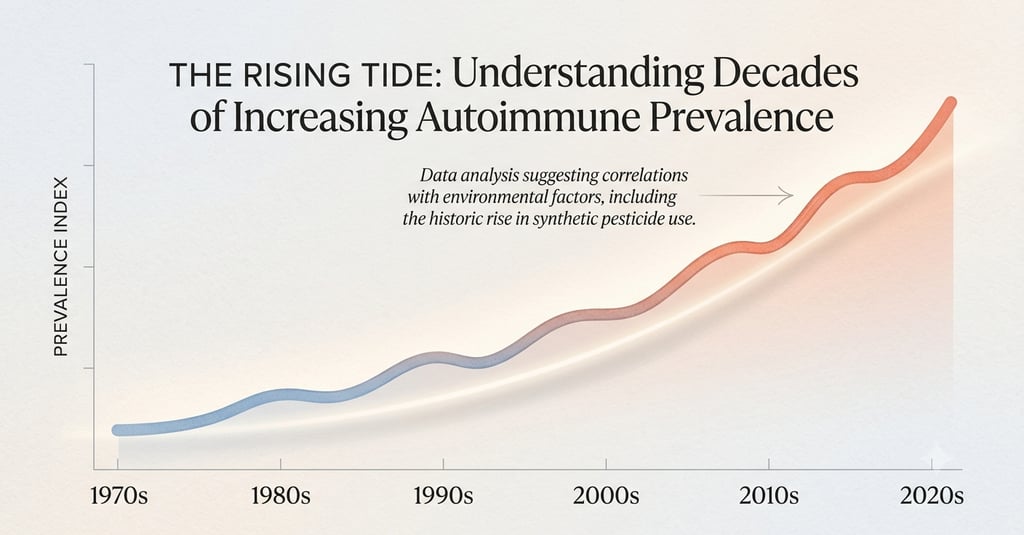
Autoimmune disease rates have climbed steadily for decades — and that rise has tracked closely alongside a massive increase in one thing: our exposure to synthetic herbicides and pesticides, especially glyphosate, the active ingredient in Roundup. It's the most widely used herbicide on the planet, applied at levels that have grown roughly 100-fold since it hit the market in the 1970s. For a growing number of researchers, that timeline overlap is too significant to dismiss as coincidence. Here's what the science actually shows — and why we think it's worth taking seriously, even before every question is fully answered.
The Case for a Real Connection
Your gut may be ground zero Glyphosate works by blocking a biological pathway that's present not just in plants, but in many species of bacteria — including the beneficial bacteria that make up your gut microbiome. Multiple studies have found that glyphosate exposure disrupts this microbial balance, shifting the ratio of beneficial to harmful bacteria. Given how central gut health has become to our understanding of immune regulation, this is one of the more compelling mechanistic explanations for how a chemical designed to kill plants could end up disrupting human immune function.
A hormone system under pressure Glyphosate has also been repeatedly identified as an endocrine disruptor — meaning it interferes with the body's hormone signaling. Animal research has linked prenatal glyphosate exposure, even at doses considered "safe," to measurable hormonal changes in offspring, including altered thyroid-stimulating hormone levels. Because the endocrine and immune systems are so tightly interwoven, disruption in one is a plausible route to dysfunction in the other.
Real changes in real immune cells This isn't purely theoretical. Studies of agricultural workers with direct occupational exposure to glyphosate have found measurable shifts in immune cell populations — including a decreased ratio of T-helper cell types associated with a higher susceptibility to autoimmune disturbances. That's a meaningful signal: it shows glyphosate exposure can alter human immune function in ways that plausibly matter for autoimmune risk, not just in a petri dish or a mouse.
Why the Evidence Isn't Uniform — And Why That's Useful Information
Not every study fits the same narrative, and we think that's worth engaging with honestly rather than ignoring. A large 2025 study on agricultural pesticide exposure and rheumatoid arthritis risk found associations between several pesticides and increased RA risk — but did not find that association for glyphosate specifically.
Rather than undercutting the broader concern, we'd argue this actually strengthens the case for taking the research seriously: it shows this isn't a blanket "all pesticides are dangerous" story that researchers are uncritically accepting. Different chemicals appear to affect the body through different mechanisms and pathways, some more strongly implicated in certain autoimmune conditions than others. Glyphosate's strongest evidence trail runs through gut and endocrine disruption — which may show up more clearly in conditions like thyroid autoimmunity or inflammatory bowel disease than in RA specifically. That's a reason to look closer at the right conditions and mechanisms, not a reason to dismiss the concern.
Why Regulators Disagree — And Why That Matters
You may have noticed that official guidance on glyphosate safety isn't consistent, and that's worth understanding rather than glossing over. The WHO's International Agency for Research on Cancer classified glyphosate as "probably carcinogenic to humans" back in 2015, based on evidence of cancer in laboratory animals and supporting human data. Other regulatory bodies, including the EPA and European Food Safety Authority, have reached different conclusions about typical exposure risk.
This kind of disagreement isn't unusual for widely used industrial chemicals — regulatory bodies often weigh economic and agricultural interests alongside health data, and safety thresholds get revisited as new research emerges. For families trying to make real decisions today, we think it's reasonable to weigh the growing body of mechanistic and occupational research seriously, rather than waiting for full regulatory consensus that may take years to arrive.
Why Children Are the Real Concern
This is where the stakes feel highest, and for good reason. Children absorb pesticides more readily than adults — hand-to-mouth behavior, time spent close to the ground, and higher food and water intake relative to body weight all add up to disproportionately higher exposure during the years their immune systems are still developing. Research on early-life pesticide exposure has found measurable changes in immune markers in children, and some researchers have specifically raised concern about what this means for autoimmune, allergic, and other immune-mediated conditions later in life.
For a generation of kids who've essentially never known a food system without heavy glyphosate use, this is exactly the kind of open question that deserves real attention — not because it's proven, but because the biological plausibility is strong and the exposure is nearly universal.
What This Means for You
We're not going to tell you the science is fully settled, because it isn't — but "not yet proven" is different from "nothing to see here." The mechanistic research is genuine, the occupational studies show real biological effects in humans, and the exposure is essentially unavoidable in the modern food system. That combination is exactly why a precautionary approach makes sense:
Wash produce thoroughly, and choose organic where it's practical — especially for foods with historically higher pesticide residue
Prioritize gut health through diet, given how central the microbiome appears to be in this picture
Reduce unnecessary pesticide and herbicide use at home
If you're pregnant, planning a pregnancy, or raising young children, this is a reasonable area to be proactive about rather than waiting for more certainty
Where We Can Help
Supporting gut health, reducing overall inflammatory burden, and building a personalized natural medicine protocol are all things we work on together — informed by this kind of research, and tailored to your specific history and exposure, alongside the care you're receiving from your medical team.
This post reflects current research as of 2026 and is for general education, not medical advice. Autoimmune disease has many contributing factors, and if you have concerns about environmental exposures and your family's health, it's worth raising with your physician.
Renew Life Clinic
Applied kinesiology and clinical protocols for chronic Lyme and autoimmune recovery.
Home-Services-About-Contact
The Practice
renewlifeclinicsupport@gmail.com
Appointments by referral & scheduling
© 2025 Renew Life Clinic Natural Medicine. -Clinical natural medicine for complex chronic conditions.
Neurological Biofeedback & Clinical Protocols